

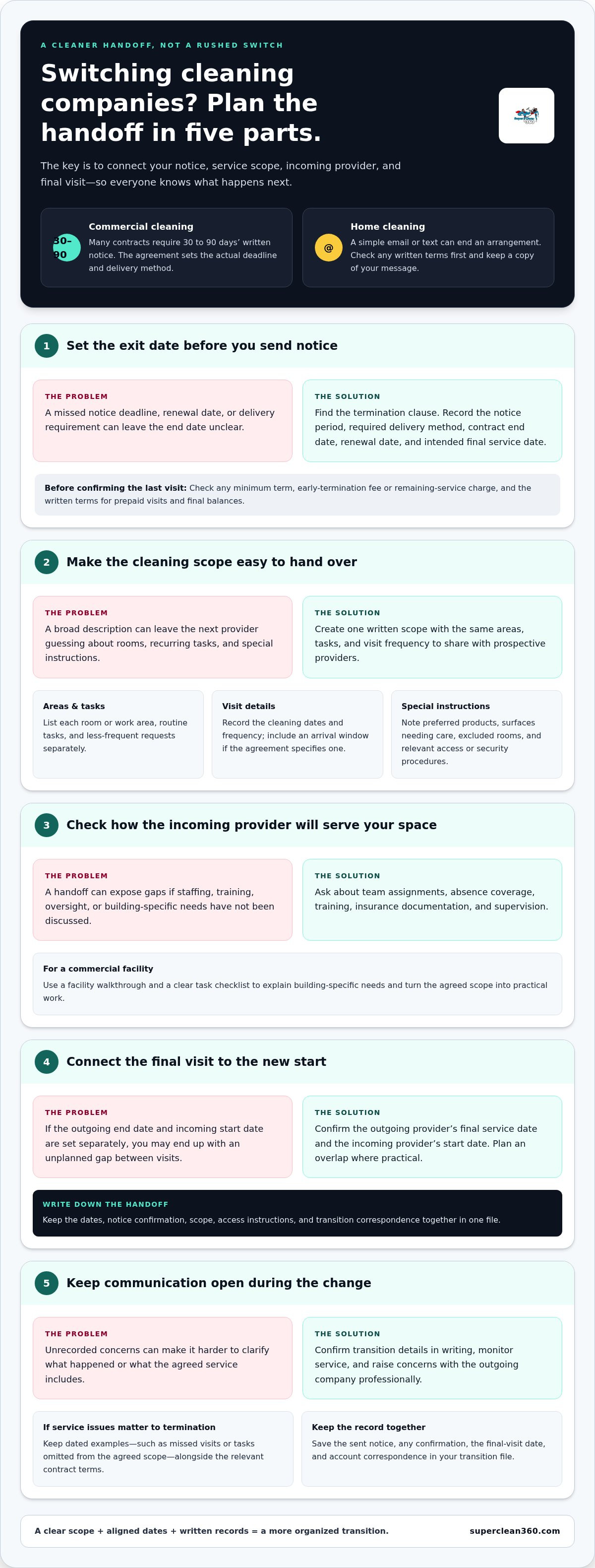
For commercial cleaning, most contracts require 30 to 90 days’ written notice, but the agreement sets the actual cancellation terms. Homeowners can end a cleaning arrangement with a simple email or text. If your decision is, “I’m switching from my current cleaning company,” start by checking the notice period and how to deliver it.
The notice date is only one part of a smooth change. Set a clear final service date, confirm when the next cleaner will start, and plan for any gap between visits. This is especially important for businesses that depend on consistent cleaning throughout their facility.
Review your contract, write a clear cleaning scope, and align the handoff with the incoming provider. During the transition, monitor service and address any concerns with the outgoing company professionally. A few practical steps can keep the change organized instead of rushed.
Key Takeaways
- Commercial cleaning contracts often require 30 to 90 days’ written notice; review your agreement for the exact deadline and delivery method.
- Record cleaning areas, visit frequency, special tasks, and access procedures so the next provider understands the service you need.
- Align the outgoing provider’s final visit with the incoming provider’s start date, and plan an overlap where practical.
- Confirm transition details in writing and keep communication active to catch service issues early.
- Assess the new provider’s staffing, training, supervision, and approach to building-specific needs before the handover.
How much notice do I need to give my current cleaning company?
For commercial cleaning, most contracts require 30 to 90 days’ written notice before termination. Your agreement sets the deadline and delivery method. At home, a simple email or text can end a cleaning arrangement, but review any written terms first.
When comparing residential cleaning companies, give each the same room list, task priorities, and preferred visit frequency. Compare how each proposed service addresses those specifics, not just its general description.
- Record the current schedule. Write down each cleaning date and frequency, such as every week or every other week. Include the usual arrival window if the agreement specifies one. This documentation shows what the current cleaning service is expected to deliver and helps identify schedule changes during the handoff.
- List every area and task. Note rooms cleaned at each visit, plus tasks completed less often. For example, record kitchen counters and floors as routine tasks, then list interior cabinet fronts as an occasional request. For a facility, identify work areas, the restroom, lobby, and breakroom separately.
- Capture special instructions. Record details that affect each visit, such as preferred products, surfaces needing special care, or rooms that should remain closed. For a home, note pet-related instructions and rooms excluded from service. For a business, document building access, security procedures, communication contacts, and emergency contacts.
- Separate included work from occasional requests. Mark which tasks happen every visit and which require a separate arrangement. For example, distinguish routine bathroom cleaning from a periodic detail task. This creates a clearer baseline and prevents a new scope from quietly adding or removing work.
- Build a comparable scope of work. Use the same area list and task descriptions for each prospective cleaner. State the service frequency beside each task, then note supply responsibilities and any special instructions. If you need a single visit while comparing recurring schedules, consider a one-time cleaning appointment.
- Match notice to your agreement and calendar. Find the termination clause, count backward from your intended final service date, and follow its stated notice method. For a commercial account, allow the required 30 to 90 days. For a home, send a concise written message and keep a copy showing the date and requested final visit.
Keep the scope, schedule, and correspondence together in one file. A dated record gives you a practical reference for confirming the final visit and preparing the incoming cleaner’s first instructions.
Reviewing contract termination and notice requirements
Most commercial cleaning contracts require 30 to 90 days’ written notice, while homeowners can usually end an arrangement by email or text. The contract controls any minimum term, cancellation fee, or prepaid-visit balance, so review those clauses before choosing a final service date.
-
Review Cancellation and Notice Terms
Find the termination clause and note the notice period, delivery method, and date the notice takes effect. Commercial agreements may require 30 days or more, and some permit mid-contract termination with 30 to 60 days’ written notice. Check whether notice must go to a named contact or address. Save a dated copy of your message and any response.
-
Address Early Termination
Read the early-termination clause before ending service ahead of the contract’s scheduled end date. Look for minimum terms, required notice, and any cancellation fee or remaining-service charge. If the agreement allows early termination after documented service failures, organize dated examples, such as missed visits or tasks omitted from the agreed scope. Keep the relevant clause and records together.
- Check renewal timing. Find the contract’s end date and any auto-renewal date, then compare them with your planned handoff. Sending notice after a renewal deadline may affect when the agreement ends. Record the dates in your calendar and set a reminder early enough to meet the contract’s notice period and delivery requirements.
- Reconcile prepaid visits and balances. Compare invoices, payment records, and completed visits against the contract’s billing terms. Ask the current company for a written account showing any prepaid service remaining and any balance due. Check how the agreement handles unused visits, credits, and final charges. Don’t assume you’ll receive a refund or that a balance will be canceled unless the written terms say so.
- Send a clear termination notice. State the contract or account name, requested final service date, and the clause you’re following. For a commercial contract requiring 30 to 90 days’ notice, calculate the deadline using its specified delivery method. For a home arrangement, an email or text can create a written record. Keep the sent message and confirmation together.
Once the notice date, final visit, and account balance are clear, record them in one transition file. A single reference helps prevent missed deadlines and disagreements about next steps.
Checking provider staffing, training, insurance, and supervision
Before setting the handoff date, assess the incoming provider’s staffing plan, training, insurance documentation, and oversight. For commercial cleaning, a facility walkthrough and clear task checklist help turn the scope into practical work.
-
Check Provider Staffing and Training
Review how the provider will assign cleaning professionals, cover absences, and train the team for your building. Ask how staff learn site-specific instructions, including restricted rooms, alarm procedures, and special cleaning tasks. A janitorial startup plan needs time for recruiting, training, scheduling, supply organization, and learning the facility. Discuss those transition needs early, rather than assuming the assigned team already knows the site.
-
Review Insurance and Supervision
Request current insurance documentation and check that the listed business name matches the provider named in your agreement. Identify who supervises the work, how often they visit, and how missed tasks are reported and addressed. A useful supervision plan names the contact for concerns and explains how management will receive updates. For specialized cleaning, document relevant site procedures and staff training before service begins.
- Set checklist expectations. Turn the agreed scope into a checklist organized by room, frequency, and task. For example, list restroom floors and fixtures separately from lobby surfaces, then mark which duties happen at every visit. Include special instructions and supply responsibilities. The checklist gives cleaning professionals a consistent reference and facility managers a clear way to identify missed work.
- Use a walkthrough to test the plan. Before service begins, walk the facility with the provider. Compare the route and task list with the actual rooms, access points, and high-traffic areas. Point out spaces that need different frequencies or instructions, such as a breakroom used throughout the day. Record agreed changes in the scope so the walkthrough produces usable documentation, not just a verbal handoff.
- Confirm communication and early oversight. Set a process for reporting missed tasks, sharing building changes, and escalating unresolved concerns. Name the facility contact and the provider’s supervisor in the handoff notes. Include early quality inspections and regular management updates in the startup plan. These steps can reveal whether training, staffing, or checklist details need adjustment before small gaps become recurring problems.
Planning an overlap between cleaning vendors
A commercial cleaning transition can take 30 to 90 days from the decision to the incoming provider’s first night. Plan the overlap around confirmed service dates, building access, and staff communication.
- Set the transition calendar. Record the outgoing provider’s final visit and the incoming provider’s first full-service date. A one- to two-week overlap is a typical commercial transition period. Use it to address site-specific questions and compare the incoming team’s work with the documented scope, rather than leaving the schedule open-ended.
- Choose the overlap tasks. Decide which areas need direct attention from both vendors during the shared period. For example, the outgoing team can maintain its usual route while the incoming team reviews priority areas and learns access procedures. Keep the scope clear so duplicate work doesn’t obscure missed tasks or create uncertainty about responsibility.
- Arrange equipment and supply staging. Coordinate where the incoming provider will place equipment and supply items, and when building access begins. For a smooth commercial handoff, equipment and supplies can be staged inside the facility 48 hours before the official start date. Record the staging location and access contact in the transition plan.
- Adapt the plan to your notice period. With 60 days’ notice, a standard switch may use days 50 to 60 for staging, then begin full service on day 61. A complex facility with 90 days’ notice may use the final two weeks for shadow-cleaning. Match the approach to the building’s size, access needs, and cleaning scope.
- Prepare facility employees and tenants. Tell affected people about the provider change before the incoming crew arrives. For commercial sites, facility managers are advised to announce the change two weeks before the switch. Include the start date, any access changes, and the contact for transition questions. A clear notice prevents confusion about who is working onsite.
- Inspect early service and refine the handoff. Review the incoming provider’s work after each of the first few services during the first week. Note specific areas that need adjustment, then share observations through the agreed management contact. A complete commercial handover can span four to six months from the initial decision through calibration, so keep communication active beyond launch.
Managing service gaps and outgoing-vendor performance
Confirm the outgoing provider’s final service date and the incoming provider’s first date in writing. Even a short gap can be noticeable in a busy office, so plan coverage around confirmed visits rather than assumptions.
- Compare the dates and identify any gap. Put both providers’ confirmed service dates on one calendar. If the outgoing company’s last visit is Monday and the incoming team starts Thursday, decide who handles Tuesday and Wednesday. For a home, consider which rooms or tasks can wait; for a business, prioritize high-traffic spaces and restrooms during the uncovered window.
- Give the current cleaner specific feedback. If a house cleaner misses a task, describe the room, task, and visit date. For example, note that the kitchen floor was missed after Tuesday’s appointment. Clear feedback gives the cleaner a practical chance to address insufficient work before you end the relationship. Keep the conversation professional and retain the written exchange.
- Assess the response, not just one mistake. Track whether the cleaner responds to concerns and whether the same issue happens again. Repeated failures to respond after you’ve discussed problems may signal that the arrangement should end. Frequent last-minute cancellations or missed appointments can also disrupt your schedule, so record dates and any notice you received.
- Monitor service through the notice period. Keep the agreed scope and scheduled visits visible during the outgoing provider’s remaining service. Record completed visits and any changes in quality, especially if the service declines or assigned workers leave before the contract ends. For a business, managers can use the scope checklist to note missed tasks and share concise, dated feedback.
- Control access at the handoff. Confirm the final service date and incoming start date in writing. On the same day the previous vendor’s contract ends, deactivate its keys, access codes, and other credentials. Manage the new provider’s access directly; don’t have the outgoing company hand keys to the incoming team. Record who received each credential and when.
- Keep communication active after the switch. Treat the first 30 days after the transition as an adjustment period. Schedule regular check-ins with the incoming provider and document issues by location and service date. A note such as “breakroom counters missed on the second visit” gives managers a clear basis for follow-up and helps address small problems before they become recurring gaps.
Super Clean 360: Standard House Cleaning
Super Clean 360’s Standard House Cleaning serves households in Berkeley and Oakland that are replacing recurring service with routine care. Share your room priorities and preferred visit frequency so the new arrangement starts with clear expectations. Deep Cleaning is a separate option when you need more intensive attention, while Move-in/Move-out Cleaning is designed for a change of residence.
Super Clean 360 is fully insured and uses professional supplies and premium HEPA-filtered vacuums. For recurring customers, the same cleaning professionals are assigned whenever possible. If agreed tasks aren’t met, a satisfaction guarantee with a free re-clean is available. These details can help you assess whether the service aligns with the needs you identified during your transition planning.
Set Up the Next Cleaning Routine
Once you’ve chosen a new service, make the first visit easier to manage by defining what a successful routine looks like for your household. Decide which rooms matter most, how you’ll communicate changes, and what should happen if a scheduled visit needs adjustment. Clear expectations give you a practical starting point with your new cleaning team.
Switching from your current cleaning company is a chance to reset details that may have become unclear or automatic. Put your priorities in writing, share updates as your needs change, and raise concerns directly rather than letting them linger. A thoughtful start makes it easier to assess whether the arrangement continues to suit your home.
When you’re ready to discuss cleaning for your home, Super Clean 360 can help you identify a suitable next step.
With a clear plan and open communication, you can make the transition with confidence.
Frequently Asked Questions
How Do I Handle Keys and Alarm Codes During the Switch?
Keep control of access credentials instead of asking the outgoing cleaner to pass them directly to the incoming team. On the contract’s final day, deactivate the outgoing provider’s keys, codes, and other credentials. Make a simple inventory of keys and alarm permissions, then arrange new access separately. At home, update shared entry codes and tell the incoming cleaner which access method is authorized.
How do I end my relationship with my cleaner?
For a household, send a brief email or text stating that you’re ending service and naming the final visit date. Keep the message professional, even if you’re leaving because of missed tasks or scheduling problems. Save the message and any reply. If you have a written agreement, follow its cancellation terms. For a commercial account, use the notice method and deadline specified in the contract.
How long should the transition between vendors take?
A commercial cleaning switch commonly takes 30 to 90 days from the decision to the incoming provider’s first service. A one- to two-week overlap is a typical transition period for commercial vendors. The practical schedule depends on notice terms, building access, staff preparation, and how complex the facility’s cleaning scope is. For a home, coordinate the final and first visits around your actual cleaning schedule.
What are red flags in house cleaners?
Repeated last-minute cancellations, missed appointments, and unanswered concerns are practical warning signs. After giving specific feedback about a task, such as an overlooked bathroom surface, notice whether the cleaner responds. Unexplained rate changes can also cause confusion; ask for a clear explanation so you can decide whether to accept the change. Keep dated notes on cancellations and concerns to see whether issues are recurring.
What should I do if my outgoing vendor reduces service in the final weeks?
Record each affected visit, the omitted task, and the date, then send the outgoing provider a concise written message. Ask which remaining visits will follow the agreed scope, and keep the reply with your service records. At a business, managers can identify priority areas that need attention before the final date. Use the contract’s performance terms to guide requests about incomplete work.
What should I include in a scope-of-work document for the new vendor?
List each room or facility area, the required tasks, and how often each should be completed. Identify who handles restroom and consumable supplies, along with communication contacts, building access, security procedures, special instructions, and emergency contacts. For example, distinguish routine lobby floor care from less frequent detail work. A clear document prevents assumptions about which tasks belong in each visit.
How do I switch from my current cleaning company to a new one?
Review your current agreement, prepare a written task list, and choose the new service schedule. Confirm the outgoing provider’s final date and the incoming provider’s start date in writing. Share building instructions and access arrangements directly with the new team, and keep a record of service during the handoff. If you’re switching from your current cleaning company at home, a dated email or text can document the change.
How much notice should I give my cleaning company before canceling?
Most commercial cleaning contracts require 30 to 90 days’ written notice, but the contract sets the actual period and delivery method. For a household cleaner, an email or text can end the arrangement; follow any written terms you have. Check renewal dates before sending notice, since timing can affect when service ends. Save a dated copy of your message and the provider’s response.


