

A cleaning plan that ignores store traffic can create as much friction as it removes. That’s the practical question behind retail store cleaning Oakland: how do you keep customer-facing areas presentable without disrupting the work of running the store?
It’s not always obvious what should come first. Entryways, sales floors, fitting rooms, restrooms, and checkout areas each have different demands, while cleaning times must account for opening hours, merchandising, and staff access. A vague service scope makes it harder to tell whether a provider’s plan actually fits your facility.
This guide explains how to set priorities by store area, coordinate a schedule with business hours and access needs, and define the tasks a commercial cleaning scope should include. You’ll also learn how a facility walkthrough can help clarify those details before comparing providers. With a store-specific plan, cleaning decisions become easier to communicate and fit more clearly around daily operations.
Key Takeaways
- Build a retail cleaning plan around customer-facing presentation as well as the store’s operational needs.
- Map sales-floor and back-of-house zones, then set priorities and cleaning frequency for each area.
- When comparing retail store cleaning Oakland proposals, check that tasks, scheduling, and access requirements are clearly defined.
- Share store hours and operational constraints during scope discussions so the plan reflects how the facility is used.
- A facility walkthrough can help clarify store-specific priorities and access needs before requesting service.
Why Retail Store Cleaning in Oakland Starts With Customer and Store Priorities
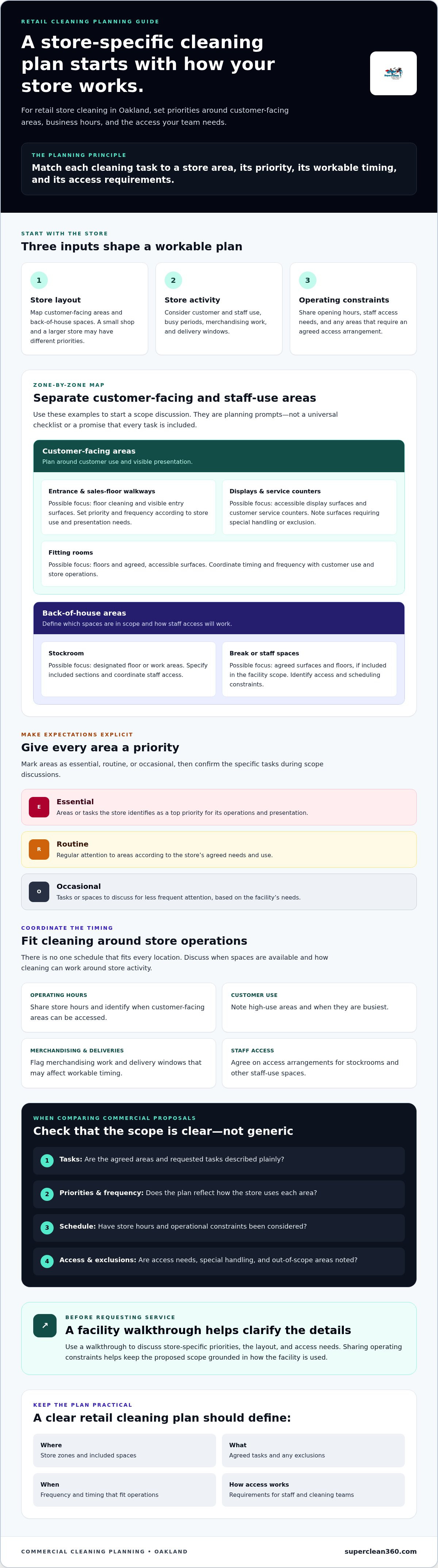
A retail cleaning plan should establish three things before tasks are assigned: which areas take priority, when cleaning can happen, and what access the cleaning team will need. For retail store cleaning Oakland managers should begin with the store’s layout and operating hours, not a generic checklist. The aim is to define work that supports the way customers use the sales floor and staff run the business.
Retail cleaning differs from general office cleaning because the sales floor is part of the customer experience. Displays, fitting rooms, and service counters are used and seen in ways that may not apply to an office. A retail scope can be described simply: It is the agreed set of cleaning tasks, priorities, schedule, and access requirements for a specific store. The broader process of removing unwanted substances can serve different purposes, but the store’s use should shape which tasks matter most.
Which store areas shape the cleaning plan?
Map the store by how each area functions. Entrances and sales floors affect the first impression and everyday shopping; display areas may need attention that fits around merchandising. Fitting rooms and customer service counters have distinct patterns of customer use. Depending on the facility, the plan may also include stockrooms and staff spaces.
These are planning examples, not universal requirements or a promise that every area is included in a service. A small shop with limited back-of-house space will have different priorities from a larger store. Managers can mark areas as essential, routine, or occasional, then confirm the specific tasks during scope discussions.
How do customer traffic and store hours affect priorities?
Consider where customers and staff spend the most time, and when those areas are available to clean. Opening hours, delivery windows, merchandising work, and staff access can all affect the workable schedule. A task that interferes with restocking or customer service may need a different time or a clear access arrangement.
- Identify high-use areas and note when they’re busiest.
- Share store hours, delivery patterns, and access constraints with the provider.
- Agree on task frequency based on the store’s needs rather than assuming one schedule fits every location.
This preparation gives managers a clearer basis for discussing priorities and scheduling. It also helps keep the proposed scope grounded in the store’s actual layout and daily operations.
How to Map Retail Cleaning Tasks Across the Sales Floor and Back of House
Turn the store layout into a working scope by listing each zone, the task to discuss, its priority, and the frequency you want considered. The examples below are prompts, not a standard checklist or confirmation that every task is included in a cleaning program. The final agreed commercial scope determines which tasks are covered.
Sales-floor priorities support customer-facing presentation; back-of-house priorities reflect how staff use and access operational spaces. Separating the two makes it easier to explain what matters and avoid leaving expectations implicit.
Entrance and sales-floor walkways
Possible focus: floor cleaning and visible entry surfaces. Priority and frequency: set according to store use and presentation needs.
Display areas and counters
Possible focus: accessible display surfaces and customer service counters. Note any surfaces that need special handling or should be excluded.
Fitting rooms
Possible focus: floors and agreed, accessible surfaces. Set the timing and frequency around customer use and store operations.
Stockroom
Possible focus: designated floor or work areas. Specify which sections are in scope and how staff access will be coordinated.
Break or staff spaces
Possible focus: agreed surfaces and floors, if these rooms are part of the facility’s scope. Identify any access or scheduling constraints.
What belongs on a sales-floor cleaning checklist?
Walk the customer route from the entrance through the main aisles, displays, fitting rooms, and service counter. Record the specific surfaces or locations you want to discuss, including areas that affect visible presentation. Customer touchpoints can be noted as focus areas, but describe the requested task plainly rather than assuming specialized disinfection is included. Managers reviewing workplace sanitation requirements can consult OSHA sanitation standards and verify which requirements apply to their facility.
How should managers account for stockrooms and staff spaces?
Include only the back-of-house rooms that apply to your store. A stockroom may hold deliveries or merchandise, while staff areas may have limited access during certain work periods. Identify restricted spaces, who can provide access, and any times when cleaning would conflict with receiving goods or staff duties. Don’t assume these areas, or specialized services, are automatically covered.
Before requesting proposals, share the zone-by-zone outline and ask providers to state the agreed tasks and frequency for each included area. This makes the scope easier to review and helps clarify any access details that still need discussion.
How to Compare Retail Cleaning Schedules and Commercial Service Scopes
Compare proposals by how clearly they define the work, not by how polished or broad the task list sounds. For retail store cleaning Oakland, a useful proposal should name the areas and tasks included, identify how often they’re scheduled, and explain timing and access. If a task or space isn’t mentioned, don’t assume it’s covered.
What should an Oakland retailer compare in a cleaning proposal?
Review each proposal against the same store-specific checklist. Confirm which areas are included, what tasks are agreed for each, and how often those tasks are planned. Ask how the schedule accounts for your operating hours, and clarify how cleaning professionals will enter the facility and which staff member coordinates access.
Also ask what’s excluded. For example, if a proposal names sales-floor floors but doesn’t specify display surfaces or fitting rooms, ask whether those are included or outside scope. Clarify who handles any tasks your store retains, how schedule changes are communicated, and whom to contact with a scope question. A written record makes differences between proposals easier to evaluate without relying on unverified rankings or performance claims.
Workplace requirements are a separate consideration from the services a provider agrees to perform. Retail managers can consult the federal OSHA sanitation standards and confirm which requirements apply to their workplace. Don’t treat a cleaning proposal as a substitute for reviewing applicable requirements.
Should cleaning happen before opening or after closing?
There isn’t one timing option that fits every store. Cleaning during operating hours may require coordination around customers, merchandising, or service activity. Scheduling outside customer hours may reduce overlap with store operations, but it depends on provider availability and clear access arrangements. Discuss what’s workable rather than assuming a provider can accommodate a particular time.
Before agreeing on a schedule, consider:
- Deliveries: Note receiving windows that may limit access to stockrooms or entrances.
- Keys and alarms: Agree on who provides access and how entry and closing procedures are coordinated.
- Staff coordination: Identify who can answer questions or communicate changes to the agreed plan.
- Customer and merchandising activity: Flag periods when cleaning could interrupt service or display work.
These details help make the scope operationally clear, but no schedule guarantees a particular result or level of customer satisfaction. Compare each proposal against your store’s priorities, access needs, and operating schedule before deciding whether its terms are clear.
How to Build a Retail Store Cleaning Plan Before Requesting Service
A short preparation process helps turn general expectations into a scope a provider can review. Before discussing retail store cleaning Oakland, gather the details that explain how your store is used, which areas need attention, and what access arrangements may be practical.
What information should you prepare for a facility walkthrough?
Use these steps to prepare. Separate confirmed needs from questions that need discussion, so the walkthrough can focus on clarifying the scope rather than guessing at your expectations.
- 1. Map the zones. List the areas you want considered, such as the entrance, sales floor, fitting rooms, stockroom, or staff spaces. Include only spaces that apply to your facility.
- 2. Rank priorities. Mark which areas matter most to store presentation or daily operations. Note any surfaces or locations that need special discussion.
- 3. Set task frequency for review. For each priority area, describe the tasks you’d like considered and how often you think they may be needed. Treat this as a starting point for discussion, not an assumed service commitment.
- 4. Plan timing and access. Share opening hours, preferred cleaning windows, delivery periods, and times when areas are occupied. Explain relevant entry procedures and identify who can coordinate access.
- 5. Write down questions. Flag uncertain tasks, spaces with restricted access, and items you need the provider to confirm as included or excluded.
How can a walkthrough clarify the final scope?
A facility walkthrough gives the store manager and provider a chance to discuss the actual layout, priority areas, scheduling preferences, and access requirements together. Bring store hours and operational constraints, including delivery windows or merchandising periods that could affect timing. Ask for the agreed tasks and frequency to be clearly recorded, along with any exclusions and responsibilities that remain with the store.
Super Clean 360’s commercial cleaning programs are customized to the agreed scope, frequency, priorities, schedule, and access needs. A walkthrough can support that conversation by letting the provider review the facility and discuss its requirements with you. The proposed plan should reflect what’s discussed, rather than assume every room or task is automatically included.
Walkthrough notes checklist
- Areas to discuss: ____________________
- Priority tasks: ____________________
- Preferred schedule and frequency: ____________________
- Store hours, deliveries, and occupied periods: ____________________
- Access procedures and store contact: ____________________
- Questions or items to confirm: ____________________
Use your notes to prepare for a conversation about commercial cleaning services.
Request a facility walkthrough
What to Expect From Retail Store Cleaning in Oakland With Super Clean 360
Once you’ve mapped the store, ranked its priorities, and noted access needs, the next step is to discuss how those details translate into a commercial cleaning scope. Super Clean 360 is a local, family-owned cleaning company that has operated since 2012. Its commercial programs are customized to the agreed tasks, frequency, priority areas, schedule, and access requirements. That means the conversation can focus on the facility and the work being considered, rather than assuming every store needs the same plan.
Before agreeing to service, make sure the proposed scope reflects what was discussed. Confirm which areas and tasks are included, how often they’re planned, and how the schedule and access arrangements will work. If a task or space is not specified, ask whether it is included or excluded. Clear documentation gives both parties a shared reference for the agreed work.
How does the commercial-only Triple-Check System™ work?
For commercial and janitorial cleaning, the 360 Triple-Check System™ involves cleaning technicians making three passes in designated focus areas. These passes are used to verify tasks against the agreed specifications. The focus areas and their requirements should be defined as part of the commercial scope, so the review is tied to the work selected for that facility.
This system applies only to commercial and janitorial cleaning. It should not be presented as part of Super Clean 360’s residential cleaning services. For retailers, the practical point is to clarify which locations are designated focus areas and what tasks the agreed specifications cover.
How do you take the next step in Oakland?
A facility walkthrough gives Oakland retailers an opportunity to discuss the store layout, priority areas, operating schedule, and access needs with Super Clean 360. Bring the notes you prepared, including store hours, delivery periods, restricted spaces, and questions about possible exclusions. The discussion can help clarify a suitable scope and identify details that need to be confirmed before service is arranged.
Super Clean 360 serves Oakland and other confirmed East Bay communities, including Berkeley, Albany, Emeryville, El Cerrito, and Richmond. Availability, timing, and the final scope should be confirmed directly. No particular schedule or cleaning outcome should be assumed before those details are agreed.
Request a facility walkthrough
Set Clear Priorities for Your Store’s Cleaning Plan
A practical retail cleaning plan starts with your store, not a generic checklist. Identify customer-facing and back-of-house areas, decide which tasks matter most, and match their frequency to how each space is used. Then compare proposals by the agreed scope, schedule, and access arrangements so expectations are clear before service begins.
For retail store cleaning Oakland managers can prepare for a facility discussion by noting store hours, delivery windows, restricted areas, and questions about what’s included. Super Clean 360 is a local, family-owned company operating since 2012, with commercial insurance coverage up to $2 million. Its commercial cleaning programs are customized to the facility’s agreed priorities and requirements.
Request a facility walkthrough
A clear starting plan makes the next conversation more focused. Your store’s layout and operational needs can guide a scope that’s easier to review and coordinate.
Frequently Asked Questions
What does retail store cleaning typically include?
Retail store cleaning may include agreed tasks for customer-facing areas such as entrances, sales floors, display surfaces, fitting rooms, or service counters. A scope might also include stockrooms or staff spaces if the retailer requests them and the provider agrees. The specific tasks aren’t automatic. For people searching “retail store cleaning Oakland,” the useful next step is to list the store’s priority areas and confirm exactly what the proposed scope covers.
How often should a retail store be professionally cleaned?
There’s no single frequency that suits every retail store. Consider how each area is used, the priorities identified by store management, and how cleaning can fit around operations. For example, managers may want to discuss a different schedule for a busy entrance than for a staff room. Agree on frequency by area and task with the provider, then review the plan if store operations or priorities change.
How do I create a cleaning schedule for a retail store?
Start by listing store zones and the tasks you want considered in each one. Rank the areas by importance, propose a frequency for each task, and note when the space is accessible. Include store hours, deliveries, merchandising periods, and times when rooms are occupied. Share those details with prospective providers and ask them to specify the agreed schedule, access arrangements, included tasks, and any exclusions in their proposal.
Can cleaning be scheduled outside store opening hours?
It may be possible, but timing depends on the store’s needs, access arrangements, and the provider’s availability. Cleaning outside customer hours may reduce overlap with shopping or merchandising, while work during operating hours may require coordination around customers and staff. Ask about possible scheduling options rather than assuming a particular time is available. Discuss keys, alarms, entry procedures, deliveries, and who will coordinate access before a schedule is agreed.
What should I ask a retail cleaning company before requesting a walkthrough?
Ask which store areas and tasks can be included, how frequency and timing are set, and how access will be coordinated. Clarify exclusions, any responsibilities the store retains, and how schedule changes or scope questions are handled. If the provider offers a facility walkthrough, ask what information to prepare and whether the walkthrough can help review store priorities and access needs. Compare proposals against the same questions, not unsupported rankings or performance claims.
Does a retail cleaning scope include stockrooms and staff areas?
Only if those spaces are included in the agreed scope. Store managers should identify the stockroom, break area, or other staff space they want considered, then clarify the tasks and frequency for each. Note restrictions such as deliveries, stored merchandise, or periods when staff need access. Don’t assume that mentioning a room means every task within it is covered; confirm inclusions and exclusions before approving the plan.
How can an Oakland retailer prepare for a facility walkthrough?
Prepare a simple floor plan or zone list, rank priority areas, and write down the tasks and frequencies you want to discuss. Share store hours, delivery windows, occupied periods, restricted spaces, and access procedures. Separate confirmed needs from questions for the provider. Super Clean 360 serves Oakland, Berkeley, and Emeryville, as well as other confirmed East Bay communities. A walkthrough can provide an opportunity to discuss the facility and clarify a possible scope.


