

The most detailed cleaning proposal isn’t automatically the right fit for your store. When comparing retail store cleaning Berkeley providers, start with how customers and staff use the space, not with a generic task list.
It’s reasonable to want clean floors, presentable customer areas, and a schedule that won’t interrupt shoppers or staff. But proposals can be difficult to compare when they cover different areas, tasks, or service frequencies. A clear scope makes those differences easier to assess and helps prevent important details from being overlooked.
This guide explains how to map cleaning tasks to your store’s layout and daily operations, compare proposals on consistent terms, and agree on scheduling and access. You’ll also learn what to clarify about communication and how to check whether recurring tasks are being completed as specified. With those details in place, you can evaluate a service plan based on how well it fits your Berkeley store, not just how extensive it looks on paper.
Key Takeaways
- For retail store cleaning Berkeley, begin with a written scope that reflects your store’s layout, priorities, and day-to-day use.
- Compare provider proposals using the same list of areas, tasks, service frequency, and access requirements.
- Plan the schedule by first identifying store hours and access constraints, then agree on priorities and frequency with the provider.
- Define observable tasks and focus areas before service begins so you can discuss any gaps clearly and specifically.
- Bring your layout, operating hours, access rules, and questions to a facility walkthrough to make scope and scheduling easier to discuss.
What retail store cleaning in Berkeley should cover
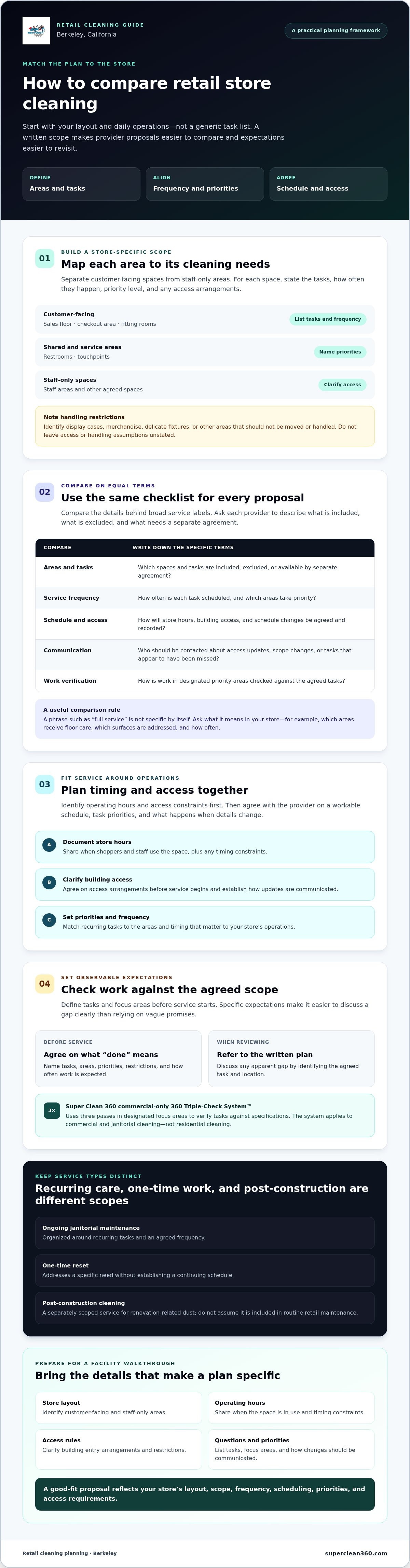
Retail cleaning is a commercial plan shaped around a store’s agreed needs. The scope should spell out which areas are included, what tasks are assigned to each area, how often they’re performed, which spaces take priority, and what access arrangements apply. A walkthrough helps turn a general request into a practical, store-specific plan.
For retail store cleaning Berkeley businesses, a sales floor, fitting rooms, checkout area, and staff space may each need different attention and timing. Cleaning can involve different methods, so clarify what each proposed task means rather than assuming every provider defines it the same way. The overview of Cleaning offers general background, but your written scope should set expectations for your store.
Which store areas should a cleaning scope identify?
Map customer-facing areas separately from staff-only spaces. Then confirm whether the proposal includes floors, touchpoints, fitting rooms, restrooms, and staff areas, and specify the tasks and frequency for each. Note display cases, merchandise, delicate fixtures, or other areas that shouldn’t be moved or handled. Documenting restrictions in advance helps prevent assumptions about what cleaning professionals may access.
How does routine retail cleaning differ from a one-time reset?
Ongoing janitorial maintenance is organized around recurring tasks and an agreed frequency. A one-time request addresses a specific need without establishing a continuing schedule. Ask the provider whether the proposed commercial scope is designed for your store and have any one-time work clearly distinguished from recurring tasks.
A newly built or renovated store may also need a separately scoped post-construction cleaning service to address renovation-related dust. Don’t assume that work is included in routine retail maintenance. Ask which areas and tasks are covered, and how the one-time request differs from any recurring plan. The appropriate scope depends on the store’s condition, layout, and agreed needs, making a walkthrough useful for setting clear expectations.
How to compare retail store cleaning services in Berkeley
Compare proposals against the same written checklist, not just their total number of tasks or broad service labels. A comparable proposal clearly states scope, frequency, priorities, and access. This gives you a practical basis for evaluating retail store cleaning Berkeley providers and spotting differences before you agree to a plan.
Use your store map and task list to build that checklist. Ask each provider to identify what’s included, what’s excluded, and what would require separate agreement. A phrase such as “full service” isn’t specific enough on its own. Ask what it covers in your store, such as which areas receive floor care, which surfaces are addressed, and how often each task is scheduled.
What questions should a Berkeley store manager ask?
Bring the same operational questions to every provider. Clarify how the schedule and building access requirements will be agreed before service starts, and what process the provider uses if those details change. For priority areas, ask how completed work is checked against the agreed tasks. The ISSA Clean Standard is a reference you can review when discussing how to make cleanliness expectations more specific.
- Which areas and tasks are included, excluded, or available by separate agreement?
- How are schedule and access details documented before service begins?
- How are scope changes communicated and recorded?
- How does the provider verify work in designated priority areas?
How can a retailer assess a provider’s reliability?
Look for a plan that reflects your actual layout and operating constraints, rather than a generic checklist. A proposal that names the relevant spaces and explains how they’ll be serviced is easier to assess and revisit than one built around undefined terms. Also establish who to contact about access updates, requested scope changes, or tasks that appear to have been missed.
Ask what verification looks like in practice. Super Clean 360’s commercial-only 360 Triple-Check System™ uses three passes in designated focus areas to verify tasks against specifications. Ask any provider to explain its own process and how it relates to the written scope, rather than assuming a named system covers every task.
Super Clean 360’s commercial cleaning programs are tailored to agreed scope, frequency, priorities, scheduling, and access requirements. A facility walkthrough can help you discuss the store’s layout and needs before deciding whether the proposed plan is a suitable fit.
Plan cleaning schedules around store hours and customer access
A workable cleaning schedule must reflect agreed access and store operations. For retail store cleaning Berkeley, don’t assume a standard time or frequency will suit your business. Build the plan with the provider around the hours your store is open, customer activity, deliveries, and the areas that need attention.
Use this sequence to prepare:
- Identify operating hours and periods when customer access must remain uninterrupted.
- List delivery windows, stock handling periods, and any areas that may be in use.
- Set priorities based on store use and the agreed cleaning scope.
- Discuss feasible service times and frequency with the provider, then document what you agree.
How should retailers decide cleaning frequency?
Frequency is a planning decision, not a universal recommendation. Consider foot traffic patterns, how the store is laid out, and which tasks are included in the service scope. For example, an entrance used throughout the day may have different priorities from a staff-only space. Discuss those differences with the provider and agree on a schedule that reflects your store, rather than relying on generic advice.
Revisit the plan if operating hours, store use, or layout changes. A schedule based on old conditions may no longer match your priorities.
What access details should be agreed in advance?
Document how cleaning professionals will enter, which areas they may access, and any instructions that affect the agreed service window. Be specific about deliveries, stock handling, alarms, keys, and restricted spaces. Clarify how schedule changes will be communicated and confirmed so both sides are working from the same information.
- Entry procedures and approved access windows
- Alarm instructions and key handling arrangements
- Restricted areas or spaces requiring permission
- Delivery periods and times when stock is being handled
- Who confirms changes to access or the schedule
Discuss timing directly with the provider. Don’t assume that cleaning can take place after closing or that a provider can accommodate urgent schedule changes. Confirm the arrangements for your specific service before they become part of the plan.
How to verify retail cleaning quality without vague promises
Set observable expectations before service starts. A useful quality check connects each agreed task to a specific area, so you can discuss what was completed, what needs follow-up, and whether a request falls outside the scope. For retail store cleaning Berkeley, clear communication is more useful than broad claims such as “spotless” or “perfect.”
Build a short checklist from the written scope. For each priority area, record the agreed task and frequency, then keep exclusions or tasks requiring separate agreement distinct. A store might list entrance floors, checkout touchpoints, and fitting-room floors as separate items if those tasks are included in its plan. Avoid adding assumptions: the provider and store should agree on the work being checked.
What should a store’s quality checklist include?
Keep the checklist consistent from visit to visit and tie it to agreed work. A manager can use a simple dated log to note a question, the relevant area or task, and the follow-up discussion. Choose one contact method with the provider for reporting concerns or requesting scope changes, and clarify how changes will be confirmed before they become part of the plan.
- Area and task, as written in the agreed scope
- Whether the item is included, excluded, or separately agreed
- A clear note about any question or requested change
- Who will follow up and how the decision will be recorded
How can retailers distinguish process claims from guarantees?
A process description explains what a provider does; it shouldn’t be mistaken for a promise of a flawless outcome. Ask how the process checks agreed tasks and how concerns are communicated. Super Clean 360’s 360 Triple-Check System™ applies to commercial and janitorial cleaning: it uses three passes in designated focus areas to verify tasks against specifications. It describes a checking process, not a guarantee that every surface will meet an absolute standard.
Be cautious of claims that don’t explain the procedure behind them. A clear scope, defined priority areas, and a consistent way to raise questions give both the store and provider something concrete to review. Keep records factual, and check whether a concern relates to an agreed task before treating it as missed work.
Use the checklist and agreed communication process to make follow-up specific and actionable.
Arrange a Berkeley retail facility walkthrough and define next steps
A facility walkthrough gives you and the cleaning provider a chance to discuss the store in context: its layout, priorities, operating hours, and access requirements. For retail store cleaning Berkeley, preparing these details in advance helps make the conversation specific. It doesn’t guarantee a particular quote or outcome, but it can clarify what the service plan needs to address.
Bring a simple store map or be ready to walk through the relevant areas. Note where customers shop, where staff work, and which spaces have access restrictions. Include recurring concerns and the tasks you want considered, without assuming they’re automatically part of the service.
What information should a retailer prepare?
Use the walkthrough to explain how the store operates as well as what you want cleaned. Be ready to distinguish routine maintenance from a one-time request related to renovation. Clear context helps the provider discuss a scope that reflects the store’s actual needs.
- Store layout, areas to include, and priority spaces
- Operating hours, access procedures, and restricted areas
- Recurring concerns and tasks you want considered
- Whether the request is for routine maintenance or post-renovation cleaning
What should happen after the walkthrough?
Review the proposed scope and confirm the tasks, frequency, priority areas, schedule, and access requirements. Check that inclusions and exclusions are explicit. If a responsibility or task remains unclear, ask for clarification before agreeing to the plan.
Super Clean 360’s commercial programs are customized around agreed requirements. Before service begins, confirm the final details with the provider, including how changes will be communicated. That gives both sides a shared reference for the work and its schedule, without assuming that service can begin immediately.
Request a facility walkthrough
Set a Clear Plan for Your Store
Choosing retail store cleaning Berkeley providers is easier when you start with a written scope, compare proposals against the same requirements, and discuss scheduling and access in light of actual store operations. Clear task descriptions and a consistent way to raise questions also make it easier to review service against agreed expectations.
Super Clean 360 is a local, family-owned company operating since 2012. Its commercial programs are customized around agreed scope, frequency, priorities, scheduling, and access. For commercial cleaning, the 360 Triple-Check System™ uses three passes in designated focus areas to verify tasks against specifications.
A facility walkthrough is a practical opportunity to discuss your layout, priorities, operating hours, and access needs before confirming next steps. With those details on the table, you can evaluate whether the proposed plan fits the way your store works.
Request a facility walkthrough
A considered plan gives you a clearer basis for working with a cleaning provider and adjusting the scope as your store’s needs evolve.
Frequently Asked Questions
What does retail store cleaning typically include?
Retail store cleaning typically covers areas and tasks listed in a store-specific commercial scope, rather than one fixed checklist. A plan may address entrances, sales floors, checkout areas, fitting rooms, restrooms, and staff spaces, but confirm each area and task with the provider. The written scope should also state frequency, priorities, and access limits. For retail store cleaning Berkeley stores should compare what’s actually included, not assume a standard package.
How often should a retail store be professionally cleaned?
There’s no universal cleaning frequency for every retail store. Consider how customers and staff use the space, foot traffic patterns, the store layout, and the tasks included in the agreed scope. Discuss these factors with the provider to set a workable schedule. Revisit the plan if operating hours, store use, or layout changes, since those shifts may affect which areas need attention and how often tasks are scheduled.
Can retail cleaning be scheduled outside customer hours?
Possibly, but don’t assume a provider offers a particular service window. Discuss your operating hours, customer access needs, delivery periods, alarm instructions, and entry procedures directly with the provider. Confirm the agreed schedule and access arrangements before service begins, including how changes will be communicated. If you need cleaning at a specific time, ask whether that timing can be accommodated for your store rather than relying on a general availability claim.
How much does retail store cleaning cost in Berkeley?
There isn’t a single price that applies to every Berkeley store, and Super Clean 360 doesn’t publish a standard retail cleaning price here. The proposed scope depends on the store’s areas, requested tasks, priorities, frequency, schedule, and access requirements. A facility walkthrough gives the provider an opportunity to discuss those details and the service plan. Ask for the agreed scope and any exclusions to be clearly documented with the proposal.
What should I ask before hiring a retail cleaning service?
Ask which areas and tasks are included, excluded, or available by separate agreement, and how often each task will be done. Clarify access procedures, scheduling, and how changes will be recorded and communicated. Ask how the provider checks work in priority areas and who to contact with questions or concerns. Super Clean 360 offers customized commercial programs in Berkeley, Oakland, and Emeryville, based on agreed requirements.
Is retail store cleaning different from post-construction cleaning?
Yes. Routine retail cleaning is planned around ongoing store operations and an agreed set of recurring tasks. Post-construction cleaning addresses a different situation, such as dust and debris following renovation, so don’t assume it’s included in routine maintenance. Ask the provider whether the requested work applies to a commercial store and have its areas and tasks scoped separately. Super Clean 360’s confirmed post-construction offering is for homes.


