
Wiping down fresh drywall dust with standard rags doesn't clean a newly remodeled home; it turns microscopic construction residue into abrasive sandpaper across your architectural finishes. Executing reliable new construction cleaning Berkeley builds require demands staged particulate containment and specialized HEPA extraction rather than rapid cosmetic dusting.
After managing months of trade schedules, city inspections, and punch lists, nothing feels more discouraging than watching pervasive white powder settle inside custom cabinetry or recirculate through fresh HVAC ductwork. You've invested heavily in premium hardwood, stone, and designer fixtures, and the fear of scratching those pristine surfaces during final cleanup is entirely justified.
This guide explains what thorough post-construction cleaning entails for your Berkeley property and how to prepare surfaces safely for move-in. We'll walk through the sequential phases of post-build debris remediation, the methods that protect high-end architectural finishes, and how to align your cleaning schedule smoothly between trade completion and occupancy.
Key Takeaways
- Learn how dedicated new construction cleaning Berkeley projects require relies on multi-stage HEPA filtration to capture microscopic drywall dust without scratching fresh paint.
- Understand the three critical phases, rough, light, and final touch-up, that keep your turnover timeline on schedule and prevent trade recontamination.
- Discover why standard domestic cleaning methods fall short against construction debris and can unintentionally abrade delicate architectural finishes.
- Review essential site readiness requirements, including confirming active utilities and clearing subcontractor trades before cleaning technicians arrive.
- Identify key qualification standards for East Bay service teams, including comprehensive liability coverage up to $2 million and tailored, manual estimates.
What Is New Construction Cleaning for Berkeley Properties?
Comprehensive new construction cleaning Berkeley projects require goes far beyond standard surface dusting. It is an intensive, multi-phase particulate remediation designed to transform an active jobsite into an immaculate, fully habitable living space. Whether completing a historic Craftsman remodel in Elmwood or finishing a modern ground-up build in West Berkeley, the industrial residue left behind by trades presents abrasive risks that ordinary domestic housekeeping cannot handle.
Post-build cleanup addresses complex particulate matter rather than everyday living dust. Leftover grout haze, volatile adhesive residue, and microscopic drywall slurry cling to fresh surfaces. Using household brooms or shop vacuums without proper filtration simply aerosolizes fine grit or damages consumer-grade vacuum motors, redistributing abrasive particles deeper into living areas.
Defining Post-Construction Cleanups
Unlike routine residential cleaning that addresses surface dirt, post-construction remediation operates as detailed architectural preservation. Professional service teams systematically strip away dense drywall film, sticker adhesives, protective films, and paint overspray from every structural element. The primary objective is delivering a completely sanitized, safe interior ready for final municipal occupancy sign-offs and immediate furniture move-in.
The Hidden Threat of Construction Dust
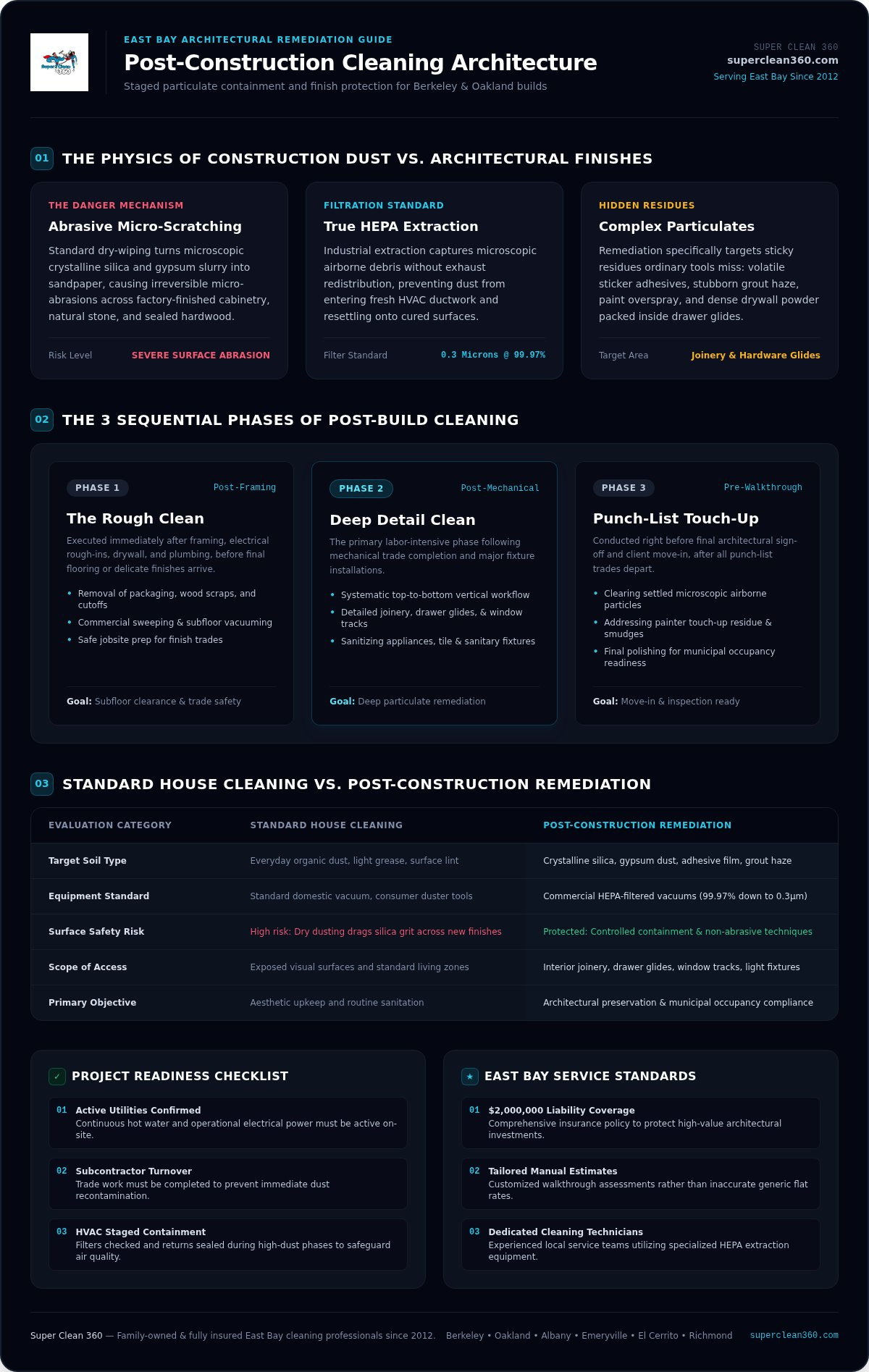
Microscopic gypsum and crystalline silica particulates represent the most pervasive post-build challenge. Because these particles remain suspended in the air for hours, they readily settle into newly installed HVAC ductwork and return registers. Once the ventilation system powers on, the air currents continuously recirculate fine dust across every room.
Particulates also lodge deep inside window tracks, door hardware, recessed light fixtures, and cabinet drawer glides. Dry-wiping this dust with dry rags or conventional duster tools drags sharp mineral grit across delicate architectural finishes, causing micro-scratches on factory-finished cabinetry, sealed hardwood, and natural stone countertops.
Safe extraction requires equipment engineered to meet strict HEPA filtration standards. Commercial vacuums equipped with true HEPA filters capture 99.97% of airborne particulates down to 0.3 microns. This containment prevents abrasive mineral dust from escaping the exhaust and resettling onto freshly cured surfaces, protecting your East Bay property investment from costly surface damage.
The Three Essential Phases of Post-Construction Cleaning
Executing successful new construction cleaning Berkeley builds demand requires strict adherence to project milestones. Trying to accomplish everything in a single visit almost always leads to wasted effort; trades inevitably track dust back across freshly polished surfaces. Dividing remediation into three distinct phases protects your investment and ensures orderly trade progression.
Phase 1: The Rough Clean
The rough clean occurs immediately after framing, electrical rough-ins, drywall installation, and plumbing are completed, but before final flooring or delicate finishes arrive. Service teams remove discarded packaging, wood scraps, and cutoffs. Cleaning technicians sweep and vacuum subfloors with commercial equipment to clear debris, creating a safe, unobstructed jobsite so subcontractors can complete final installations without kicking up underlying grit.
Phase 2: The Deep Detail Clean
Once mechanical trades finish and major fixtures are installed, the primary detail cleaning begins. This labor-intensive phase tackles the heavy accumulation of fine dust using a systematic top-to-bottom workflow. Cleaning professionals detail ceiling fans, door casings, window sills, and interior cabinetry joinery, including drawer glides where abrasive dust hides. Fresh kitchen appliances, sanitary bathroom fixtures, and architectural tile are thoroughly wiped down. Following EPA best practices for indoor air quality during this phase keeps fine dust contained so it doesn't escape into newly conditioned rooms.
Phase 3: The Final Punch-List Touch-Up
Even after deep cleaning, minor trade work often takes place; painters touch up baseboards, and carpenters adjust cabinet doors. Airborne particles agitated during earlier phases also take time to settle completely. The final touch-up occurs shortly before the architectural walkthrough or municipal inspection. Technicians wipe down all horizontal surfaces, remove stray fingerprints from polished glass, and perform a final high-filtration vacuum pass. If you're coordinating final occupancy following renovation, scheduling a dedicated move-in cleaning ensures the space remains pristine before your furnishings arrive.
Standard House Cleaning vs. Post-Construction Remediation
Homeowners often assume that routine housekeeping techniques work just as well on a newly built or renovated space. In reality, recurring maid service maintains existing finishes, whereas professional post-construction remediation strips away aggressive industrial residues. Treating construction debris like typical household dirt damages both your property and consumer-grade equipment.
Standard vacuums lack the internal sealing needed for microscopic particles. Drawing drywall dust, mortar residue, and sawdust into a typical domestic vacuum quickly clogs standard paper filters, bypasses motor seals, and causes immediate motor burnout. The exhaust blowers then spray fine silica throughout the home, undoing hours of labor.
Equipment and Filtration Standards
Remediation service teams deploy commercial equipment featuring fully sealed canisters and commercial-grade HEPA filters. These systems trap particles down to 0.3 microns without blowing fine powder through exhaust ports. In addition to advanced machinery, physical wipe-downs rely on staged microfiber techniques. Technicians continually fold cloths into clean sections and use neutralizing solutions. This prevents fine grit from rubbing against fresh polyurethane floor finishes or factory-sprayed cabinetry.
Specialized Residue and Adhesive Removal
Beyond capturing dust, new construction cleaning Berkeley properties require calls for the safe dissolution of tough installation materials:
- Window and appliance film: Protective stickers bake under California sunlight during construction, leaving sticky chemical residue on window glass. Technicians use specialized lubricants and non-abrasive tools to release adhesives without scratching glass coatings.
- Grout haze and silicone residue: Fresh tile installations often leave cloudy cementitious films across shower surrounds, and plumbers frequently leave stray caulking beads around basin rims. Removing these requires balanced chemistry that releases polymers without etching surrounding marble, quartz, or unsealed grout lines.
- Local regulatory compliance: Commercial cleanup ensures waste sorting aligns with City of Berkeley green building and debris recycling requirements, which require at least 65% waste diversion for qualifying residential alterations.
If your East Bay property has lived through months of settled household dust without active construction, our standard one-time house cleaning handles thorough seasonal resets. Active construction turnover, however, strictly demands dedicated industrial remediation.
Preparing Your Berkeley Project for Professional Post-Build Cleaning
A seamless transition from construction zone to finished home requires deliberate site preparation. Before scheduling new construction cleaning Berkeley properties require, general contractors and property owners must coordinate the site environment. Bringing service teams in while trades are actively working wastes resources and leads to immediate recontamination.
Timing your cleanup correctly ensures that every hour spent detailing architectural surfaces delivers lasting results. Ensuring specific utilities and clearances are in place allows technicians to work safely and efficiently.
Site Readiness Checklist
To prepare your jobsite for thorough post-build detailing, confirm the following prerequisites before your service team arrives:
- Active utilities: Reliable electrical power is necessary to run commercial HEPA vacuums and task lighting, while running hot and cold water is essential for safe surface wiping and rinse solutions.
- Trade completion: All active sanding, saw-cutting, caulking, and paint touch-ups must be finished and fully cured so airborne dust has settled.
- Site clearance: Subcontractors should remove heavy power tools, staging ladders, leftover lumber, and hazardous scrap materials from interior walking paths.
- HVAC servicing: Turn off ventilation fans during initial dust capture, then replace all furnace and intake filters immediately after the deep cleaning pass to prevent cycling trapped grit through the home.
Local Berkeley Architectural Considerations
Berkeley homes present unique structural nuances that dictate cleaning strategy. Historic brown-shingle homes and Craftsman residences in neighborhoods like Elmwood or the Claremont district often feature intricate picture rails, restored redwood wainscoting, and deep window casings. These period woodwork details require precise hand extraction with soft-bristle vacuum attachments to pull fine debris out of historic joints without scuffing aged patinas.
Modern hillside builds across the Berkeley Hills often feature vast glass walls, minimalist flush-panel cabinetry, and multi-level floor plans. In these properties, microscopic dust clings electrostatically to high-gloss finishes and deep window tracks. Cleaning technicians systematically work downward through vertical elevations, ensuring particulates are extracted rather than pushed down onto lower levels.
Request professional move-in cleaning services
How to Choose a Reliable Post-Construction Cleaning Team in the East Bay
Selecting the right provider protects your newly completed build. Construction turnover requires technical expertise, specialized equipment, and comprehensive insurance backing. When evaluating options for new construction cleaning Berkeley general contractors and homeowners should look beyond basic housekeeping directories to verify operational qualifications and local accountability.
Verifying Commercial Coverage and Safety
Pristine quartz counters, custom white oak flooring, and designer plumbing fixtures represent substantial financial investments. Verifying that your cleaning provider carries comprehensive commercial general liability insurance up to $2 million provides essential protection against accidental surface scratching or chemical etching.
Experienced service teams understand the exact chemistry required to lift grout haze and construction adhesive without compromising delicate sealants. As a local, family-owned business operating continuously across Berkeley, Oakland, and Albany since 2012, Super Clean 360 deploys dedicated cleaning technicians trained specifically in fine architectural finish care.
Requesting a Tailored Project Estimate
Automated booking calculators cannot accurately price post-construction remediation. An online widget quoting purely by bedroom count fails to account for heavy drywall dust volume, window sticker residue, ceiling heights, or active punch-list trade traffic. Reliable cleaning companies avoid flat-rate estimates for post-build projects, opting instead for customized assessments.
- Overall square footage: Include both conditioned living areas and finished basements or accessory dwelling units (ADUs).
- Renovation scope: Note whether the work was a ground-up new build, an extensive gut remodel, or a targeted kitchen and bath update.
- Specialty materials: Identify unsealed natural stone, custom cabinetry finishes, or expansive multi-pane glass walls that require dedicated care.
- Project schedule: Establish your target inspection dates and move-in timeline so phases can be coordinated without trade overlap.
Providing detailed architectural scope information allows cleaning professionals to calculate exact labor requirements and arrive with the necessary commercial HEPA equipment. Contact our team today to request a tailored estimate for your Berkeley project and secure a smooth, stress-free move-in.
Step Into a Pristine, Move-In-Ready Berkeley Home
Transforming an active renovation into a comfortable, safe living environment requires deliberate care rather than hurried cosmetic dusting. Phased particulate containment, commercial HEPA extraction, and non-abrasive residue removal protect custom finishes from accidental surface scratching. When properly scheduled after final trade work wraps up, professional detailing ensures your interior stands ready for punch-list walkthroughs and immediate occupancy.
Operating locally as a family-owned East Bay company since 2012, Super Clean 360 brings industrial-grade equipment and up to $2 million in liability coverage to deliver reliable new construction cleaning Berkeley homeowners and builders depend on. Our dedicated service teams handle the complex remediation so you don't have to carry the physical burden alone.
Take pride in your finished project and enjoy stepping into a spotless space designed for everyday living.
Frequently Asked Questions
How does post-construction cleaning differ from regular house cleaning?
Post-construction remediation addresses industrial residues rather than routine living dust. Standard house cleaning focuses on light maintenance dusting, surface mopping, and bathroom sanitization. In contrast, new construction cleaning Berkeley builds require targets abrasive drywall gypsum, crystalline silica, grout haze, and manufacturer adhesive labels. It uses heavy filtration and surface-safe chemistries designed to prevent abrading brand-new architectural woodwork, stone, and delicate plumbing fixtures.
When should I schedule new construction cleaning during my build timeline?
Schedule cleaning only after all physical construction, sanding, painting touch-ups, and major punch-list trades have entirely finished. If subcontractors continue saw-cutting or adjusting drywall after cleaning begins, fine particulate will resettle immediately across cleaned areas. For optimal results, coordinate the initial deep detail clean roughly two to three days before your final municipal building inspection or official staging installation. This timing gives airborne dust sufficient time to settle out completely.
Do your cleaning technicians bring their own equipment and supplies?
Yes, our service teams arrive fully equipped with all necessary commercial-grade tools and specialized supplies. We supply commercial HEPA-filtered vacuums designed to capture fine gypsum and silica without motor burnout. Our cleaning professionals also bring microfiber textiles, extension poles for tall window frames, and surface-safe cleaning agents tailored to luxury architectural materials like quartz, unsealed wood, and custom metal hardware. You don't need to supply any materials on the jobsite.
Why is HEPA filtration necessary for construction dust remediation?
True HEPA filtration is necessary because microscopic drywall and silica dust easily penetrate standard domestic vacuum filters. Standard vacuum bags and paper filters vent particles smaller than 10 microns right back into the indoor air. Commercial HEPA filters capture at least 99.97% of particulates down to 0.3 microns. Using HEPA extraction prevents microscopic minerals from continuously recirculating through newly installed HVAC ductwork, protecting indoor air quality before your family or tenants occupy the property.
Can you clean newly installed appliances and custom cabinetry inside and out?
Yes, comprehensive interior detailing of brand-new millwork and kitchen appliances is a core part of our post-build scope. Fine wood sawdust and drywall dust routinely settle inside cabinet joinery, shelving, and soft-close drawer tracks during construction. Cleaning technicians vacuum interior cabinet boxes with soft brush attachments, wipe down shelving faces, remove protective plastic packaging films from stainless steel appliances, and polish exterior surfaces without leaving streaks or micro-abrasions on factory paint.
What utilities must be active on-site prior to the cleaning team's arrival?
Fully operational electrical power and running water must be active on-site before our service teams arrive. Cleaning professionals require working 120V wall outlets to power commercial HEPA extraction vacuums and inspect deep corners using task lighting. Reliable hot and cold running water is equally vital for mixing neutralizing rinse solutions and washing microfiber cloths. If utilities are disconnected or intermittent, please reschedule your service date until municipal connections are established.
How do I receive a quote for my Berkeley post-construction project?
You can receive an accurate, customized quote by submitting your project specifications directly through our website or contacting our office. Because every remodel or build features distinct architectural materials, square footage, and debris volume, new construction cleaning Berkeley projects require a manual estimate rather than flat-rate automated booking. Once you share your square footage, timeline, and site conditions, our family-owned team prepares a transparent, tailored scope to protect your project investment.


