

There isn’t one standard price for every home, so the answer to “how much does a deep clean cost Berkeley?” depends on the home and the work requested. To get a useful estimate, describe the size and layout, current condition, and areas you want the cleaning team to focus on.
“Deep clean” can mean different things from one request to another. A one-time deep clean is generally more detailed than routine house cleaning, but the service label alone doesn’t tell you which tasks are included. The proposed scope matters as much as the estimate when you compare options.
This guide explains what information can shape an estimate, how to distinguish deep cleaning from standard or move-related cleaning, and what to prepare before requesting a quote. These steps can help Berkeley homeowners and renters compare proposals based on the work described, rather than on a broad price that may cover a different home or scope.
Key Takeaways
- There’s no single answer to how much does a deep clean cost Berkeley; the home’s details and agreed one-time cleaning scope shape an estimate.
- Describe the home’s size, layout, current condition, and areas that need attention when requesting an estimate.
- Compare deep cleaning with standard and move-related cleaning by purpose, timing, and requested tasks, not by the service label alone.
- Prepare a clear summary of your home, priorities, and areas of focus so the proposed scope can be discussed clearly.
- Super Clean 360 offers one-time residential deep cleaning in Berkeley and is a local, family-owned company that has operated since 2012.
How Much Does a Deep Clean Cost in Berkeley? Start With Scope, Not a Guess
There’s no single figure that suits every Berkeley home. A useful estimate reflects the home’s details and the agreed scope of a one-time residential cleaning, rather than a generic number. The same service label can describe different requests, so the estimate should make clear which areas and tasks are being considered.
Homes with similar layouts may still need different work. One household may want the cleaning focused on a few rooms, while another may request attention throughout the home. Sharing those priorities helps make the estimate more specific and gives you a better basis for comparing proposals.
What a deep-clean estimate is meant to cover
An estimate connects the home’s details to the residential cleaning tasks being requested. It shouldn’t suggest that every deep clean follows an identical checklist. The term can be used broadly; a general overview of housekeeping practices and definitions provides context, but a quote needs to address the specific home and requested work.
Compare the described scope, not just the headline figure. Check whether estimates address the same rooms, priorities, and requested tasks. For example, if you want particular attention given to a kitchen and bathroom, name those areas in your request. That makes it easier to see whether proposals are based on comparable work, without assuming that an unmentioned task is included.
If an estimate uses broad wording, ask what parts of the home or tasks that wording covers. A clear description helps you understand what the proposed service includes and what falls outside the request. This is more useful than relying on the label “deep clean” alone.
When a one-time deep clean may fit
A one-time deep clean may suit a household looking for a detailed residential service for a particular need. It can fit when you want a single visit focused on your priorities, rather than ongoing upkeep on a regular schedule. The scope should still reflect the home and the work you’re requesting.
Recurring maintenance serves a different purpose: it supports the home’s upkeep over time. A one-time service lets you address a specific cleaning need without setting up a continuing routine. To make your request clearer, describe the reason for the visit and which areas matter most to you.
Before requesting an estimate, decide what you want the visit to address and how broadly you want the work considered. Then compare proposals based on the tasks each one describes. A well-defined request keeps the discussion centered on your home and helps you assess whether the proposed scope suits your needs.
Which Home Details Can Shape a Berkeley Deep-Clean Estimate?
For Berkeley households, a deep-clean estimate depends in part on the amount and type of work the home needs. Size matters, but it isn’t the only consideration. Layout, current condition, and requested tasks help describe the scope. Sharing these details makes an estimate more specific without creating a universal formula for calculating a total.
Similar floor areas can involve different work. A home with several rooms may need a different approach from a more open layout of comparable size. Multiple levels can also affect how the work is organized. Sharing the room count and basic layout helps clarify the home being considered, even if you don’t know its exact square footage.
Home size, layout, and condition
Start with the details you know: approximate size, number of rooms, and whether the home has more than one level. Then describe its current condition in straightforward terms. For example, you might mention that some rooms have had less regular upkeep or that particular areas need extra attention. This context helps explain the requested work, but it doesn’t automatically determine a set fee.
Be candid and specific. You don’t need to label the home “easy” or “difficult” to clean. Describe where attention is needed and whether you’re requesting work throughout the home or in selected areas. That gives the estimate discussion useful context without asking you to predict the time or effort involved.
Requested tasks and areas
Before requesting an estimate, identify the rooms and tasks that matter most. You could note that you want to discuss a particular kitchen area, bathroom, or other room, or identify a lower-priority space. Naming your preferences clarifies the request; it doesn’t mean every area or task is automatically included.
Describe what you want addressed rather than relying only on the phrase “deep clean.” Service labels can be broad, while your priorities are specific. A clear description gives you and the cleaning team a practical starting point for discussing the scope. It also helps prevent a request for one set of tasks from being compared with an estimate based on another.
Access and timing details can matter for planning. If there are entry instructions or scheduling constraints relevant to coordinating the visit, include them in your description. These details help frame logistics, but they don’t establish a particular appointment time or imply an added charge.
To prepare, gather the home’s size or room count if available, a brief description of its condition, your priority areas, and the tasks you’d like to discuss. Add any relevant access or timing context. This concise overview gives your estimate request a clear foundation while leaving the scope and estimate to be shaped around your specific home.
Deep Cleaning vs. Standard or Move-Related Cleaning: Compare the Right Scope
Choose a service by the purpose of the cleaning, not just by how thorough you want it to be. A one-time deep clean is a detailed residential service. Standard house cleaning supports ongoing maintenance, while move-related cleaning is shaped by a change in occupancy. Identifying the situation helps you describe the work and compare estimates based on the proposed scope.
For a useful comparison, make sure each estimate responds to the same kind of request. A deep-clean estimate may not be comparable to one for routine upkeep or a move transition, because each has a different purpose. Use the table to identify which scope fits your circumstances and what to clarify.
| Service type | Purpose | Typical timing | Scope question to consider |
|---|---|---|---|
| One-time deep cleaning | A detailed clean for a specific residential need | As a single visit | Which rooms or areas should receive priority? |
| Standard house cleaning | Ongoing upkeep of the home | On a recurring schedule | What routine tasks should be addressed from visit to visit? |
| Move-in or move-out cleaning | Cleaning connected to a move or change of occupancy | In relation to moving in or out | What does the home need for this transition? |
How deep cleaning differs from recurring house cleaning
A deep clean addresses a specific, detailed request, while recurring house cleaning is arranged to maintain the home over time. A single deep-clean visit doesn’t establish a continuing schedule, and routine visits shouldn’t be assumed to include every task someone might associate with a deep clean. When comparing these options, consider whether you need focused attention for one occasion or regular upkeep.
For example, you may want one detailed visit without arranging future appointments. Or you may be looking for ongoing cleaning as part of your household routine. Stating which goal matters to you makes it easier to discuss the right scope. Super Clean 360 offers recurring house cleaning as well as one-time deep cleaning in Berkeley, Oakland, and Emeryville.
When a move-related service is the closer fit
A move changes the context of the cleaning request. If you’re leaving a home or preparing to move into one, explain that transition and describe the areas you want addressed. This helps distinguish the request from a general one-time deep clean. Move-related cleaning doesn’t promise a particular landlord decision or deposit outcome; it’s a separate service scope to consider when cleaning is connected to a move.
If there’s no move involved and you want a single detailed clean, describe that need directly. If the visit relates to moving in or out, make the transition clear in your request so the estimate can reflect the purpose and priorities of the job.
How to Prepare for a Deep-Clean Estimate in Berkeley
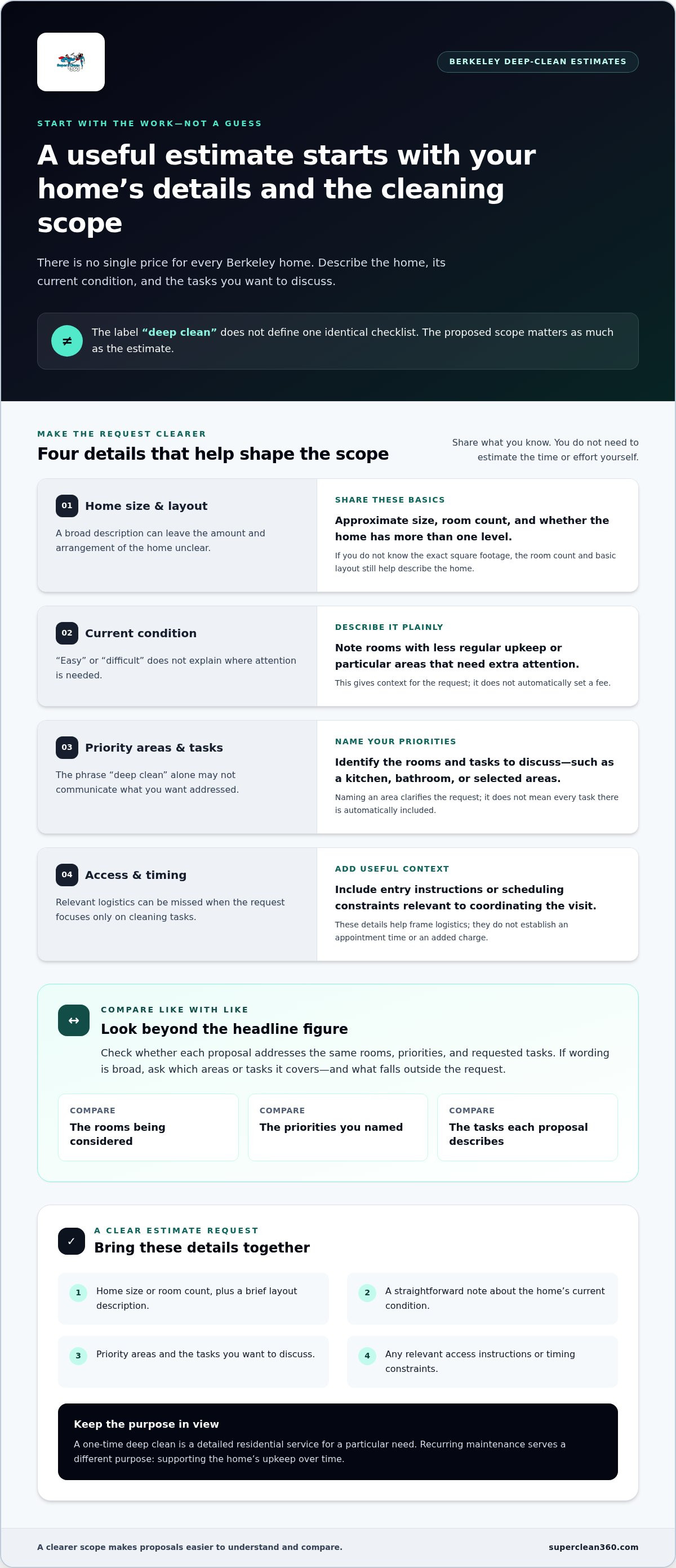
A clear estimate request starts with a useful description of your home and the work you want considered. The answer to how much does a deep clean cost Berkeley depends on those specifics, so a little preparation can make it easier to understand what an estimate covers and compare it fairly.
Gather what you already know. You don’t need a perfect inventory; focus on details that help describe the home, your priorities, and practical planning considerations.
Information to gather before requesting an estimate
- Describe the home. Share its approximate size if you know it, the number of rooms, and whether it has multiple levels. If you don’t know the square footage, room and layout details can still help explain the space.
- Identify your priorities. Name the rooms or areas you’d like to focus on and describe the tasks you have in mind. Treat these as requested priorities, not an assumption that every item is automatically part of the service.
- Share relevant planning details. Mention access instructions or timing constraints that could affect coordination. These details help with planning; they don’t establish that a particular appointment time is available.
A short, organized description is often more useful than a long list of every household concern. For example, explain which rooms matter most, what needs attention, and whether you’re requesting a single detailed clean. If a particular area is lower priority, say so. That keeps the estimate discussion focused on the scope you’re actually considering.
How to compare estimates fairly
Before comparing totals, compare the work each estimate describes. A lower or higher figure alone doesn’t tell you whether two proposals cover the same home or tasks. Check that the room count, layout information, condition details, priority areas, and requested scope are consistent across the estimates.
Look for differences in what’s included or excluded. If one estimate discusses the whole home and another addresses only selected rooms, they aren’t describing the same request. If a task you care about isn’t clearly addressed, treat it as an open scope question rather than assuming it’s included. This is more useful than relying on a general benchmark for what a Berkeley deep clean “should” cost.
Keep your notes nearby when you request an estimate. A concise summary of home details, priorities, and planning needs helps make the request easier to review. It also gives you a practical reference for checking whether an estimate reflects the service you intended to request. For details about the one-time service, see Super Clean 360’s one-time deep house cleaning.
Request a Berkeley Deep-Clean Estimate From Super Clean 360
Super Clean 360 provides one-time deep house cleaning for Berkeley homes. The company is local and family-owned, and has operated since 2012. For a single detailed residential clean, an estimate request gives you a way to describe your home and priorities so the proposed scope can reflect the work you’re seeking. The company also serves Oakland and Emeryville.
If you’re still asking how much does a deep clean cost Berkeley, focus on getting an estimate based on your specific home rather than relying on a broad figure. Share the details you’ve gathered, including the layout, areas you want prioritized, and any relevant access or timing information. Clear information helps frame the request without assuming that every possible task is part of the service.
What to expect from the residential service
The service is intended for a one-time, detailed residential clean. Super Clean 360 provides professional cleaning supplies and equipment and uses premium HEPA-filtered vacuums. These are details about the equipment and supplies used, not a promise of a particular health or environmental outcome.
Before the visit, be clear about the tasks you’ve agreed on and the areas they cover. That shared understanding gives you a useful reference for the service. If an agreed residential task doesn’t meet expectations, you may contact the company for a free re-clean of the task that wasn’t completed to the agreed scope.
Keep your estimate notes for reference, especially if you’ve identified priority rooms or specific requests. If your needs change, clarify the revised scope rather than assuming the original estimate covers additional work. This helps keep expectations aligned with the agreed tasks.
Take the next step
Once you’ve outlined the home and your priorities, you’ll have the key details ready to request an estimate for the one-time service. A clear request starts with the information that matters to your household, without relying on a generic price or assuming a particular scope. You can also review the details of one-time deep house cleaning.
Make Your Next Cleaning Decision With Confidence
A clear estimate can help turn the question of how much does a deep clean cost Berkeley into a practical decision about the service that fits your home. Before you proceed, consider what you want the one-time visit to address and whether the proposed scope reflects those priorities. You can then decide with a better understanding of what you’re requesting, rather than relying on a broad figure that may describe a different home or service.
You don’t need to have every detail figured out before taking the next step. Start with the home information and priorities you know, then use the estimate process to clarify the proposed residential cleaning scope. That gives you a straightforward way to decide whether a deep clean fits your household’s needs.
Frequently Asked Questions
Why can deep-clean estimates differ between homes in Berkeley?
Estimates can differ because homes vary in layout, condition, and requested work. For example, two homes with a similar number of rooms may have different priorities: one request may focus on a few areas, while another may cover more of the home. The question of how much does a deep clean cost Berkeley is best considered in relation to the specific home and agreed scope, not a general benchmark.
Does a deep clean include the same tasks as standard house cleaning?
Not necessarily. Deep cleaning and standard house cleaning are different service scopes, so the name alone doesn’t establish which tasks are included. A household might request a one-time detailed clean for particular areas, while routine service is intended for ongoing upkeep. Before agreeing to a service, review the task descriptions and note any priority items you want addressed. Don’t assume an unmentioned task is included simply because the service is called a deep clean.
Is a one-time deep clean different from move-out cleaning?
Yes. A one-time deep clean addresses a detailed residential cleaning need, while move-out cleaning is associated with leaving a home or preparing it for a change in occupancy. If you’re moving and have a specific handover or transition in mind, describe that context when requesting an estimate. A move-related service doesn’t guarantee a deposit return or landlord approval; clarify the requested scope for your situation.
What information should I provide when requesting a deep-clean estimate?
Share the home’s approximate size if known, room count, layout, and any areas that need particular attention. Describe the tasks you have in mind, then mention relevant entry instructions or timing constraints that affect planning. If you’re unsure how to describe a task, identify the room and the concern rather than assuming a specific cleaning method. This gives the estimate request useful context without requiring you to calculate the work yourself.
Are professional cleaning supplies included with a Super Clean 360 residential cleaning?
Yes. Professional cleaning supplies and equipment are provided for residential cleaning, and Super Clean 360 uses premium HEPA-filtered vacuums. You can focus your estimate request on the home, the areas you want prioritized, and the tasks you’d like to discuss rather than planning to supply standard cleaning equipment. These service details describe the supplies and equipment used; they aren’t a claim about health or allergen outcomes.
Do recurring-cleaning discounts apply to a one-time deep clean?
No. Recurring-cleaning discounts don’t apply to a one-time deep clean. The discounts are tied to recurring schedules: weekly cleaning has a 20% discount, biweekly cleaning has a 15% discount, and monthly cleaning has a 10% discount. If you’re requesting a single detailed visit, consider it separately from a recurring plan when reviewing the estimate. The estimate should reflect the service and scope you’ve requested.


